Removing Black Box Dye Safely: A Staged Colour Correction
Black box dye is one of the most unpredictable starting points in professional colour correction.
In this case, the client wanted to move away from dark artificial pigment, but the priority was not speed.
The priority was to remove colour safely, protect the condition of the hair, and build a controlled path forward.
The Starting Point
The client presented with:
- 3 months of black box dye
- previous colour history
- copper
- blonde natural base
- black box dye
This combination created multiple layers of artificial pigment, making the hair highly unpredictable during lightening.
Without strand testing, lifting black box dye becomes unpredictable — increasing the risk of uneven results, breakage, and unnecessary damage.

Structural Analysis Before Any Colour Work
Using SalonLab® analysis, we assessed the hair before deciding how far the correction could safely be taken.
The analysis showed:
- Hair Strength: 67%
- Cuticle Condition: Raised
This confirmed that the hair required a controlled, staged approach rather than aggressive lightening.
The hair was compromised but workable.
Careful product choice, controlled lifting, and a staged plan would be essential.
Strand Testing — Removing Guesswork
Before proceeding, two strand tests were carried out using different formulations.
Test 1:
- Lightener + 3%
- Lifted evenly and cleanly
Test 2:
- Lightener + 3% with Cool Lift
- Lifted less cleanly
Key observation:
Both tests revealed:
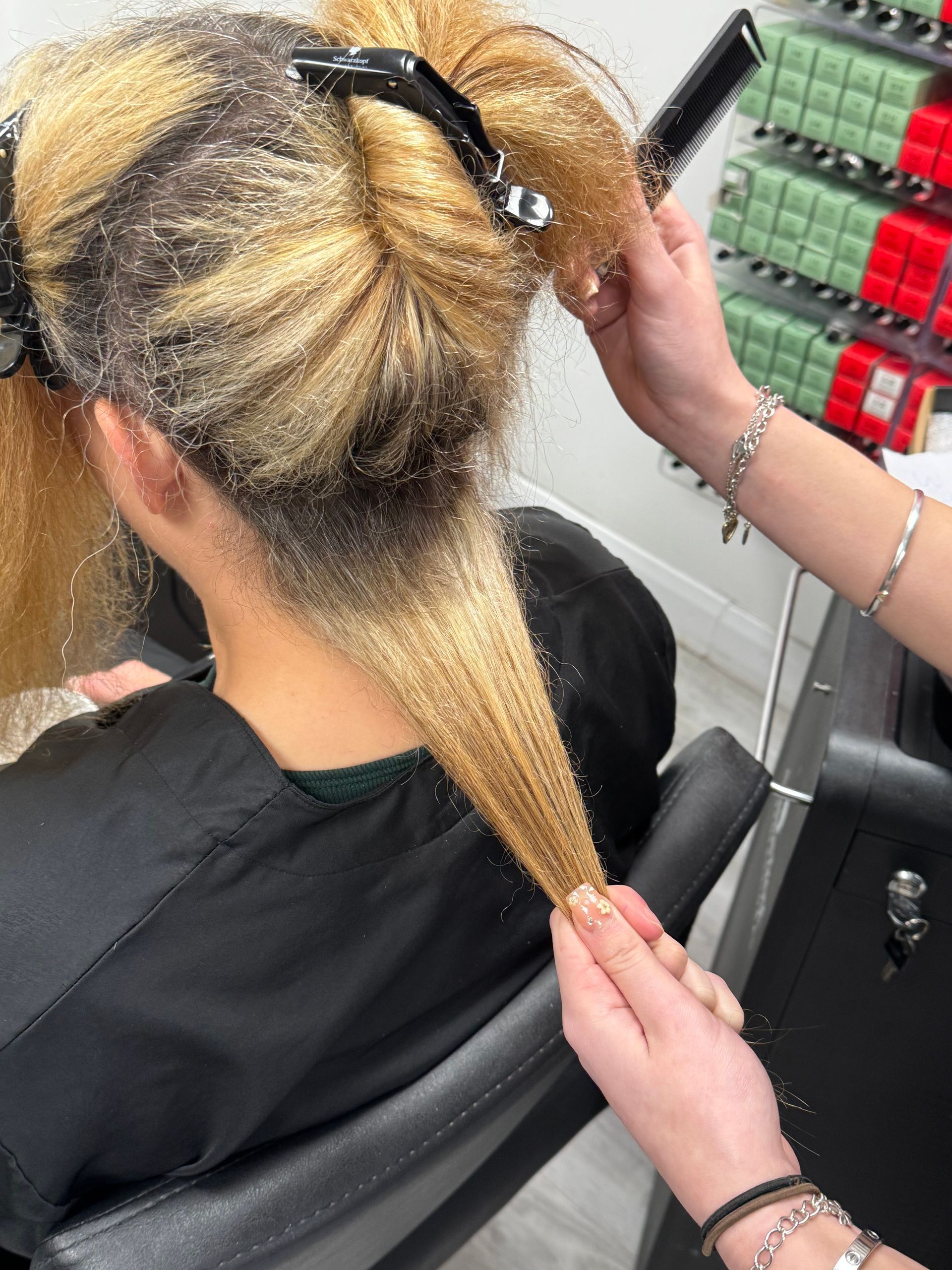
- strong orange undertones
- expected result when lifting black box dye
This allowed us to choose the safest and most controlled approach before applying colour to the full head.


Session One — Controlled Pigment Removal
What we did in session one:
- full-head lightener
- applied only to box-dyed areas
- controlled processing
- toner to refine tone
- treatment to stabilise condition
- blow-dry finish
The goal was not to achieve blonde in one session.
The goal was to safely remove artificial pigment while maintaining the integrity of the hair.
By limiting application to box-dyed areas and controlling the lift, we created a more predictable result without unnecessary stress to the hair fibre.
Why We Didn’t Push To Blonde
Although further lightening may have been possible, it would not have been the right decision.
Pushing further could have:
- compromised the hair
- made the result less durable
- affected how the hair looked and felt
- reduced the options available for future sessions
The decision was to stop at a controlled warm stage, preserve integrity, and build towards a better long-term result.
This is a common misconception — colour correction is not always about getting to the
final result in one appointment.

The Result After Session One
After one session:
- artificial black pigment was successfully lifted
- warm underlying tones were revealed
- hair condition was maintained
- structure was preserved for future sessions
This was not the final result.
It was the correct first stage.
The Plan Moving Forward
For this client, the correction was planned in stages.
For this client, the next step was to allow the hair time to settle before reassessing.
At the next appointment, the plan would be to:
- reassess hair condition
- repeat strand testing
- determine suitability for further controlled lightening
- consider blonde highlights if the hair allowed
This approach gives the hair the best chance of progressing safely rather than being pushed too far too soon.
Prescribed Homecare
Homecare is not an add-on after colour correction.
It is part of the correction plan.
To support the hair between sessions, the client was advised to use:
- Fortify Shampoo
- Fortify Mask
- Hydrate Leave-In Conditioner
- Light Bonding Oil
- BLONDME Deep Repair Mask
This matters because the hair must improve before further lightening is considered.
The stronger and more supported the hair is between sessions, the better the long-term result can be.
The Truth About Box Dye Removal
Previously applied box dye can lift unevenly. This is why box dye can create more complexity than many clients expect.
It does not behave predictably.
And it cannot be safely removed in one step without risk.
This is why correction work is planned, tested, and staged.
At THE TRUTH IN COLOUR®, we do not guess.
We assess the hair, test where needed, control the process, and build the result safely.
Maintaining The Result
Maintaining the result achieved through colour correction requires the correct aftercare.
Explore recommended aftercare products →
Thinking About Removing Box Dye?
Every correction starts with understanding what your hair can safely achieve.
Your consultation allows us to assess the hair, understand the colour history, test where needed, and create a plan designed to protect the condition of the hair.
If you are unsure what is possible, begin with a consultation.
Results like this are built over time — not rushed in one appointment.